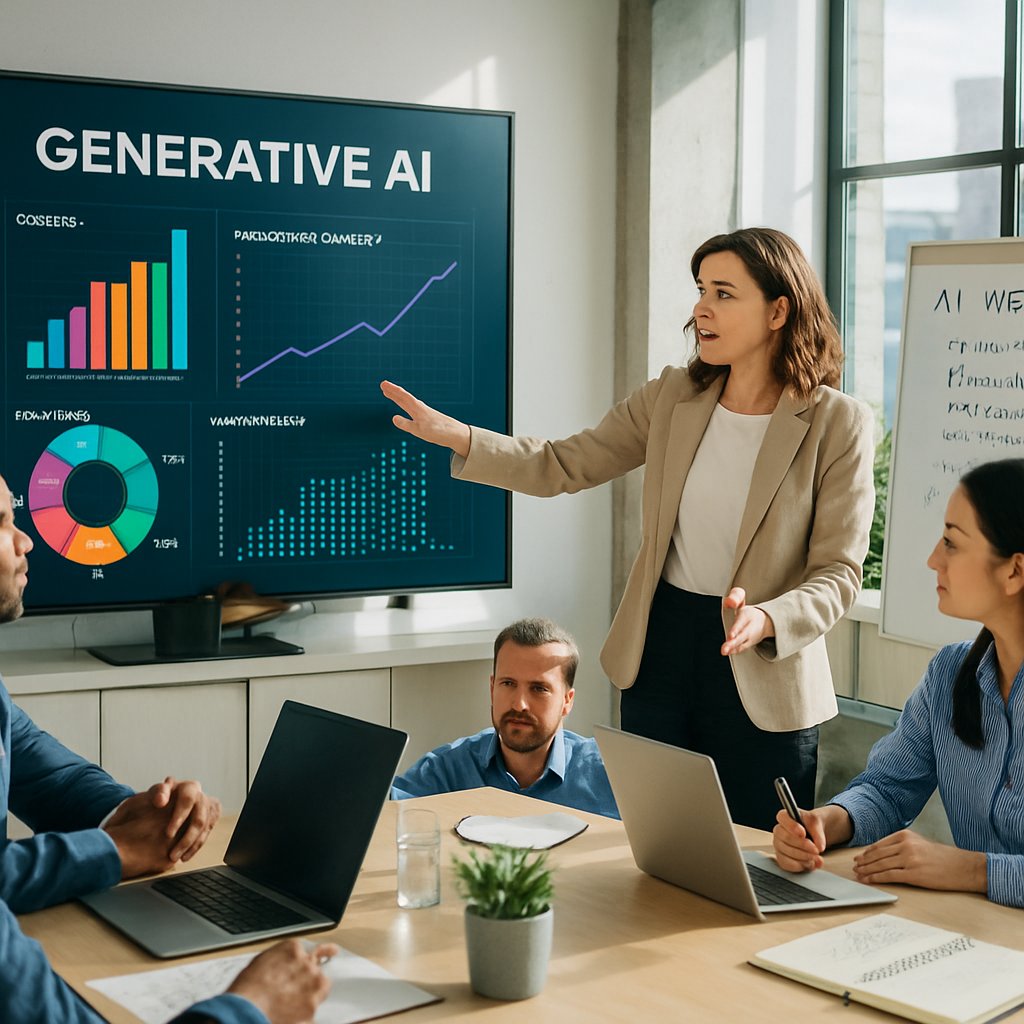
Unlocking Gen AI's Potential for Enterprise Transformation

The Rise of Generative AI in Modern Enterprises
Generative AI (Gen AI) is rapidly becoming a cornerstone of modern enterprise operations. Its ability to drive smarter operations, faster decision-making, and new levels of efficiency is transforming how businesses function across the globe. Unlike traditional AI, which focuses on recognizing patterns and making predictions based on existing data, Gen AI can create new content, solutions, and insights, pushing the boundaries of innovation.
The Hackett Group® is at the forefront of this revolution, offering comprehensive Gen AI consulting services that help enterprises explore, implement, and scale Gen AI across core business operations. By leveraging Digital World Class® benchmarks, proven transformation frameworks, and empirically validated best practices, they enable organizations to maximize return on investment (ROI) and reduce implementation risk.
Strategic Development: Aligning Gen AI with Business Goals
For any Gen AI initiative to be successful, it must be aligned with the strategic business objectives of the organization. The Hackett Group® excels in developing Gen AI strategies that are tailored to the unique needs and goals of each enterprise. This strategic development begins with a thorough capability assessment to understand the current state of AI readiness within the organization.
Opportunity mapping follows, identifying areas where Gen AI can deliver the most significant impact. This includes creating a practical roadmap that outlines how to implement and scale Gen AI across various business functions. By aligning the Gen AI vision with business goals, organizations can ensure that their AI initiatives are both effective and sustainable.
Assessing AI Readiness: Identifying Gaps and Opportunities
Before diving into Gen AI implementation, it's crucial to assess the organization's readiness for such a transformative technology. The Hackett Group® conducts comprehensive AI readiness and gap assessments, evaluating the existing data, systems, governance, and infrastructure. This assessment helps uncover capability gaps and outlines the necessary remediation steps to ensure a secure and scalable foundation for Gen AI.
Understanding these gaps allows organizations to address them proactively, reducing the risk of implementation failures and ensuring that the AI initiatives are built on a robust foundation. This step is essential for setting the stage for successful Gen AI adoption and long-term operational efficiency.
Discovering High-Impact Use Cases for Gen AI
Identifying and prioritizing high-impact use cases is a critical aspect of Gen AI consulting. The Hackett Group® utilizes its proprietary Hackett AI XPLR™ platform to discover and evaluate potential use cases across different business functions. Each opportunity is assessed for feasibility, value, and strategic fit, ensuring that organizations focus on initiatives that deliver the greatest return on investment.
High-impact use cases for Gen AI span various business functions, including finance, HR, IT, and supply chain. For example, in finance, Gen AI can streamline reporting, forecasting, and compliance processes. In HR, it can enhance recruitment, onboarding, and workforce planning. By prioritizing these use cases, organizations can achieve significant efficiency gains and improved decision-making.
Selecting the Right Technology Stack for Your AI Needs
The success of Gen AI initiatives heavily depends on selecting the right technology stack. The Hackett Group® helps organizations identify the optimal tech stack tailored to their specific use cases. This involves evaluating various AI models and technologies based on performance, response speed, cost-efficiency, and customization capabilities.
For instance, when a large language model (LLM)-based solution aligns with a use case, The Hackett Group® assesses key factors to select the best model. This meticulous selection process ensures that the chosen technology aligns with the organization's business objectives and delivers the desired outcomes. By leveraging the right technology, organizations can develop solutions that are not only effective but also scalable and sustainable.
Industry-Specific Applications and the Benefits of Gen AI
Generative AI's transformative potential is evident across various industries, each benefiting uniquely from its capabilities. In banking and financial services, Gen AI can improve customer onboarding, credit decisioning, regulatory reporting, and risk management. Retailers can use Gen AI for demand forecasting, inventory management, personalized marketing, and customer engagement.
Healthcare organizations can implement Gen AI to enhance clinical decision support, automate administrative workflows, and improve patient engagement. In supply chain and logistics, Gen AI drives operational efficiency through planning support, exception management, compliance monitoring, and performance tracking. Manufacturing industries benefit from Gen AI in production monitoring, quality control, supply chain optimization, and workforce training.
The benefits of adopting Gen AI are manifold, including enhanced efficiency, improved decision-making, and significant ROI. By integrating Gen AI into their operations, organizations can achieve smarter decision-making, streamlined processes, and enterprisewide innovation.
Conclusion
Generative AI is revolutionizing enterprise operations by driving innovation, efficiency, and smarter decision-making. The Hackett Group® provides end-to-end Gen AI consulting services that help organizations explore, implement, and scale Gen AI initiatives. From strategic development and AI readiness assessments to use case discovery and technology selection, their comprehensive approach ensures that businesses can achieve measurable results.
As industries continue to evolve, the adoption of Gen AI will become increasingly critical for staying ahead of the competition. By leveraging The Hackett Group's expertise, organizations can confidently navigate the Gen AI journey and unlock its full potential for enterprise transformation.